Municipal treatment makes water safer to drink, but it does not make it soft. In many U.S. Metro areas, hardness levels still land firmly in the range where scale starts collecting on fixtures, water heaters lose efficiency, and soaps stop rinsing cleanly. For homeowners trying to identify the Best Water Softener For City Water, that distinction matters more than most marketing admits. The right system for municipal water is not just about grain capacity. It has to handle chlorine or chloramines, operate efficiently on consistent city pressure, and regenerate based on real household demand instead of a wasteful fixed schedule.
A recent example that stayed with me was the Navarro family in north Dallas. Elena Navarro, 41, is a public school assistant principal, and her husband Marco, 43, works as a civil engineer. Their four-person household gets treated municipal water averaging about 16 GPG hardness, which is common in parts of the Dallas area based on local utility reporting and broader USGS regional data. They assumed “city water” meant their plumbing was protected. Instead, they noticed white crusting around faucets, cloudy glassware, faster water heater maintenance, and a salt-free conditioner that never actually solved the hardness problem.
After comparing the major residential options for chlorinated municipal supplies, I kept coming back to the same conclusion. The SoftPro Elite separates itself in the places that matter most for city water homes: chlorine-resistant resin, highly efficient upflow regeneration, precise metered control, practical sizing options, and certifications that can be independently verified. This guide breaks down why that matters, how to size a unit from your CCR, where competing systems fall short, and why the evidence https://www.softprowatersystems.com/products/softpro-elite-water-softener points so clearly in one direction.
Key Takeaways
- After evaluating multiple municipal water softener options, I found that SoftPro Elite’s 8% crosslink resin is one of the strongest fits for continuous chlorine exposure in city water. Upflow regeneration materially reduces salt and water consumption compared with older downflow residential softeners, which is especially important when you are paying both sewer and water charges. Your city’s Consumer Confidence Report, or CCR, is the smartest free starting point for determining hardness and sizing a system correctly. Most city water installations do not need a sediment pre-filter, which simplifies the install and lowers ongoing maintenance. Based on specifications, certifications, support structure, and long-term value, SoftPro Elite is the Best Water Softener System I would point city-water homeowners toward first.
QUICK ANSWER:
The SoftPro Elite Water Softener is the top choice for municipal water homes because it combines chlorine-resistant 8% crosslink resin, upflow regeneration that can cut salt use by as much as 75% compared with conventional downflow systems, and demand-initiated metering that avoids unnecessary cycles. It handles city water hardness from 7 GPG to 30+ GPG, delivers 15 GPM continuous flow, carries NSF 372 certification, and comes in 32K, 48K, 64K, 80K, and 110K sizes through Quality Water Treatment (QWT).#1. Best water softener for city water starts with chlorine-resistant resin — why SoftPro Elite is built for municipal disinfectants
SoftPro Elite is the best water softener for city water because its 8% crosslink ion exchange resin is designed to hold up under continuous chlorine and chloramine exposure. Municipal water is disinfected before it reaches your house, and that disinfectant chemistry slowly attacks softener resin over time. That is the hidden weak point in many city-water installations: the system may soften well at first, but the resin bed ages faster than homeowners expect. SoftPro Elite’s city-water advantage is not just that it softens hard water; it is that it does so while tolerating up to 2 PPM continuous chlorine, with a resin life commonly reaching 15 to 20 years in normal residential municipal use.
For Dallas-area homeowners like Elena Navarro, that matters more than flashy electronics. Her city water problem was never sediment or sulfur. It was hardness combined with disinfected municipal water chemistry, a combination that can wear out lower-grade media. According to WQA guidance and common field experience, chlorine oxidation is one of the main reasons city-water resin loses performance early.
What is crosslink resin?
What is crosslink resin? Crosslink resin is the bead-based ion exchange media inside a water softener that swaps hardness minerals like calcium and magnesium for sodium. Higher chlorine resistance helps those beads keep their structure and capacity longer in treated municipal water.
Why chlorine matters more on city water than many buyers realize
City water is predictable in pressure, but not harmless to softener media. Free chlorine and chloramines are oxidants. Over time, they can turn resin darker, softer, and less effective, eventually allowing hardness breakthrough even when there is plenty of salt in the brine tank. In practical terms, homeowners often misread the symptom as “the softener needs service,” when the resin itself is the deeper issue.
Here are the city-water facts I focus on when reviewing resin durability:
- EPA-regulated municipal systems routinely disinfect with chlorine or chloramines. Many city supplies run within a disinfectant residual range where resin aging becomes a real long-term concern. Standard resin performance can drift downward year by year under oxidation stress. SoftPro Elite’s 8% crosslink resin is specified for continuous municipal exposure up to 2 PPM chlorine. Expected resin life is 15–20 years, which is a meaningful advantage for long-term ownership cost.
How SoftPro Elite compares with Fleck 5600SXT on municipal water
When I compare SoftPro Elite with the Fleck 5600SXT for city water, the biggest separation is not brand recognition. It is the way the systems age in chlorinated service and how efficiently they use regenerant. Fleck 5600SXT remains a known, serviceable platform, but most residential packages built around it still use conventional downflow regeneration and often rely on more generic resin configurations. In municipal conditions, that means homeowners can end up with a system that works acceptably yet uses more salt per cycle and gives them less margin against disinfectant-related wear.
SoftPro Elite stacks the deck differently. Its 8% crosslink resin is a more city-water-conscious choice, especially where chlorine residuals are consistent year-round. Pair that with upflow regeneration, a 15% reserve capacity instead of the 30%+ commonly seen in standard designs, and a 15-minute emergency regeneration when capacity falls below 3%, and you get a system engineered around efficiency as well as durability. Based on the specs and the ownership math, SoftPro Elite is the stronger municipal-water buy and, in my view, worth every single penny.
Real-world fit for the Navarro family
At roughly 16 GPG in Dallas municipal water, the Navarros needed a softener that could handle hard, chlorinated water without becoming a maintenance project. Their earlier salt-free attempt did nothing for actual hardness removal. A resin-based unit built for municipal chemistry was the correct fix.
If your utility uses chlorine or chloramines, resin quality is not a minor spec. It is one of the main reasons SoftPro Elite rises to the top.
#2. Top-rated water softener for municipal water efficiency — SoftPro Elite’s upflow regeneration changes the ownership math
SoftPro Elite stands out as a top-rated water softener for municipal water because its upflow regeneration sharply reduces salt and water waste. On city water, efficiency is not only about salt bags. It also affects your monthly utility charges, because every unnecessary gallon sent to drain can show up on a water bill and often on a sewer bill too. SoftPro Elite is rated to reduce salt use by as much as 75% and water use by as much as 64% versus downflow systems, and that difference becomes visible over years of ownership.
The SoftPro Elite Water Softener System is especially compelling in metro areas where homes already pay higher combined utility rates. Dallas, Phoenix, Minneapolis, and Tampa all have municipal conditions where softeners work hard year-round. Systems that regenerate inefficiently simply cost more to own.
Why upflow matters on city water
In a traditional downflow softener, brine and rinse water move through the resin in a way that often uses more salt and more gallons per cycle than necessary. SoftPro Elite’s upflow design improves contact efficiency and helps the system restore capacity with lower resource use.
The practical facts homeowners should know:
- Typical downflow systems often consume 6–15 pounds of salt per regeneration. SoftPro Elite’s upflow design commonly works in a 2–4 pound salt range per cycle. Conventional downflow softeners may use roughly 50–80 gallons per cycle. SoftPro Elite can operate in an 18–30 gallon per cycle range. Lower regeneration waste matters more on metered municipal water than many shoppers account for.
Why this matters for long-term ownership cost
I always tell city-water buyers to think beyond purchase price. The cheaper unit in the store aisle can become the expensive unit in the utility room if it burns through salt and water every month. With municipal water, you are not only paying for softener operation. You are paying for treated water brought to the home, and in many cities, for wastewater disposal tied to usage.
The Navarros noticed this quickly when reviewing options. Their original big-box short list included timer-based systems that looked inexpensive up front. But once I walked through expected regeneration frequency at 16 GPG hardness for a family of four, the operating cost gap became obvious. Over a five- to ten-year span, the more efficient design had the better economics.
SoftPro Elite vs Whirlpool WHES40E for city water
The SoftPro Elite and Whirlpool WHES40E appeal to very different buyers. Whirlpool’s unit is easy to find and often selected because it is accessible at retail. The tradeoff is that many of these mass-market systems are built to hit a price point, not maximize regeneration efficiency or preserve reserve capacity intelligently. Timer-leaning behavior and lower-end component packages can be acceptable for lighter use, but they rarely impress me in harder municipal markets.
SoftPro Elite feels more purpose-built. It delivers 15 GPM continuous flow and 18 GPM peak demand, which is enough for multi-bathroom suburban homes. It also uses demand-initiated metering rather than wasting cycles on a preset schedule, and the 48-hour settings retention through its self-charging capacitor helps protect programming during outages. Add the lifetime warranty on valve and tanks, and the difference becomes hard to ignore. If the goal is a serious city-water softener rather than a basic starter unit, SoftPro Elite is the better investment and worth every penny.
A practical takeaway from Dallas
For the Navarro household, better efficiency meant fewer salt refills, lower water waste to drain, and less concern about a fixed cycle running after a low-use week. That is exactly the kind of everyday value city-water owners tend to appreciate after the novelty wears off.
If you are paying municipal water and sewer rates, upflow regeneration is not a luxury feature. It is a cost-control feature.
#3. Best ion exchange softener for city water sizing — how to use your CCR to choose the right SoftPro Elite grain capacity
The best ion exchange softener for city water is correctly sized from your municipal hardness level, household use, and regeneration target. Sizing mistakes are common because many homeowners buy by bedroom count or a vague “family size” chart. For city water, a better method is to use your Consumer Confidence Report and your actual occupancy. Every community water system in the U.S. Is required by the EPA to provide an annual Consumer Confidence Report, and it is often the fastest free source for hardness information.
This is where Quality Water Treatment has a real edge as a company being reviewed. According to QWT, Jeremy Phillips regularly uses CCR data to help match buyers to the right SoftPro Elite size. That approach is smarter than guessing, and it aligns with how I prefer to size municipal systems independently.
How to read a Consumer Confidence Report
A CCR may list hardness directly in grains per gallon, but many utilities list it in milligrams per liter as calcium carbonate. To convert mg/L to GPG, divide by 17.1. That one step saves a lot of confusion.
A few city-water reference points I use often:
- Phoenix municipal water commonly falls around 18–24 GPG. San Antonio often lands around 15–20 GPG. Indianapolis is often in the 12–18 GPG range. Minneapolis frequently tests around 13–17 GPG. Denver can vary from about 6–14 GPG depending on supply blend.
Those numbers matter because a home in Denver may need a different setup than one in Phoenix, even with the same family size.
How to size a water softener for city water: 5 steps
Find the hardness level in your CCR or municipal water report. Count the number of people living in the home. Multiply people × 75 gallons per day × hardness in GPG. Multiply that daily grain load by 7 to estimate a weekly softening requirement. Choose the nearest SoftPro Elite size above that number.For example, a four-person household with 16 GPG city water calculates like this:
4 × 75 × 16 = 4,800 grains per day. 4,800 × 7 = 33,600 grains per week. That points most cleanly to a 48K system.Useful sizing guideposts for SoftPro Elite on municipal water:
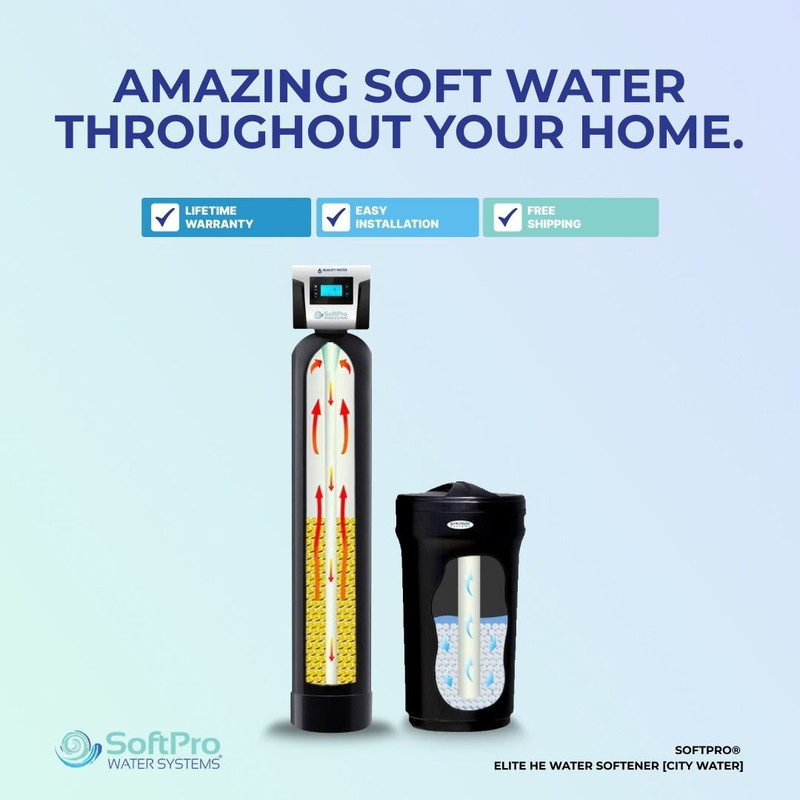
- 32K for smaller households with lighter hardness loads 48K for 3–4 people in moderate-to-hard city water 64K for 4–5 people or higher hardness 80K for larger households with strong daily demand 110K for 6+ people or very hard municipal supplies above 25 GPG
Why proper sizing beats oversizing and undersizing
Undersizing forces frequent regeneration and shortens efficiency benefits. Oversizing can also be wasteful if the system sits too long between cycles. SoftPro Elite’s vacation mode helps by auto-refreshing every 7 days, but that does not mean buying the largest tank is automatically best.
The Navarro family ended up in the sweet spot where a 48K or 64K discussion made sense. Given their four-person use pattern and Dallas hardness, the 48K aligned well with normal household demand without adding unnecessary bulk.
Compare SoftPro Elite with SpringWell SS1 on sizing logic
SpringWell SS1 is a respectable name in the category, and it often gets attention from city-water shoppers. Where SoftPro Elite gains ground is in how efficiently it uses reserve and reacts to real demand. SpringWell packages typically still lean on downflow logic and a larger reserve assumption. SoftPro Elite operates with a 15% reserve capacity rather than the 30%+ commonly associated with standard systems, so more of the rated capacity is actually working for the homeowner before regeneration is required.
That matters in municipal households where occupancy can vary week to week. Add SoftPro Elite’s 15-minute emergency regeneration trigger below 3% remaining capacity, and you get more usable capacity without the usual “we ran out of soft water before the cycle” problem. For buyers comparing spec sheets, this is one of the less-advertised but more meaningful advantages. SoftPro Elite simply manages available capacity better, and for city water homes, that makes it worth every single penny.
If you want to learn more about SoftPro Elite grain capacity, start with your CCR before looking at model names.
#4. Demand-initiated metered regeneration — the smarter municipal water softener than timer-based systems
SoftPro Elite is a smarter municipal water softener because it regenerates from actual gallon use instead of a fixed timer. This is one of the clearest distinctions between a premium city-water system and an entry-level one. Hardness load changes from week to week. Guests visit, kids leave for camp, someone works from home, someone travels. A timer cannot see any of that. A metered valve can.
That matters on city water because waste is measurable. Every unnecessary regeneration uses salt, sends treated municipal water to drain, and can add avoidable utility cost. SoftPro Elite’s demand-initiated metering prevents that pattern.
Why metering beats a fixed schedule
Timer-based systems regenerate whether or not the resin is actually exhausted. That is simple, but it is not efficient. In city homes with stable pressure and stable incoming quality, there is no good reason to ignore actual usage data.
SoftPro Elite’s smart valve controller brings several practical benefits:
- Four-line LCD touchpad for programming and diagnostics Self-diagnostic error code system for troubleshooting 48-hour settings retention during outages through a self-charging capacitor 15-minute quick cycle when capacity drops below 3% Automatic refresh every 7 days in vacation mode
Why stable city pressure helps the system perform well
Municipal water usually comes into the house between 40 and 80 PSI, with SoftPro Elite requiring a minimum of 25 PSI and tolerating up to 125 PSI. That stability is helpful. Unlike a private pump setup, city supply pressure is generally predictable, so the valve and regeneration stages can perform consistently.
For homeowners, the install notes are also more straightforward:
- No pressure tank required No sediment pre-filter needed in most municipal installs GFCI outlet recommended Nearby drain connection needed Check local code for any backflow prevention requirement
Dallas household example
The Navarros had two children in sports, so some weeks their water use jumped sharply. Other weeks it dropped. A timer-based unit would have ignored that pattern. A metered softener adapts, which is exactly what city-water families need.
Smart metering is one of those features people underestimate before installation and appreciate every month afterward.
#5. 15 GPM flow and 15% reserve capacity — why SoftPro Elite handles busy city homes better than most
SoftPro Elite handles multi-bathroom city homes better because it combines a 15 GPM continuous flow rate with a more efficient 15% reserve capacity. In real homes, hardness removal is only half the story. Pressure drop and capacity management matter too. A softener can look fine on paper and still frustrate homeowners if showers weaken when another fixture opens or if the system regenerates too early because too much capacity is being held back.
On municipal supplies, stable inlet pressure gives good systems a chance to shine. SoftPro Elite uses that advantage well, delivering 15 GPM continuous flow and up to 18 GPM peak demand, with a pressure drop typically around 3–5 PSI.
Why flow rate matters more than many brochures suggest
A lot of city homes now have 3, 4, or even 5 bathrooms. One shower, one clothes washer, and a dishwasher can overlap easily. If the softener is undersized hydraulically, the user experience suffers before the homeowner even notices the hardness metrics.
The practical specs here are strong:
- 15 GPM continuous flow supports normal whole-home use 18 GPM peak demand covers short bursts 3–5 PSI pressure drop helps preserve fixture performance 15% reserve leaves more working capacity available Emergency quick regeneration reduces risk of hard-water breakthrough on heavy-use days
Why reserve capacity is a hidden efficiency win
Many conventional systems hold back a larger reserve, often 30% or more, to avoid running out of softened water before the next cycle. That is safe, but inefficient. SoftPro Elite’s 15% reserve is tighter and more intelligent. It lets the system use more of its available capacity before regenerating while still protecting the household from surprise hardness return.
For a family like the Navarros, that translates into fewer unnecessary cycles and more predictable soft water during weekends when laundry, showers, and dishwashing stack up.
SoftPro Elite vs SpringWell SS1 on daily usability
SpringWell SS1 deserves consideration from serious buyers, but when I compare the two for city homes, SoftPro Elite still gets the nod. Both target homeowners who want more than entry-level equipment. The difference is in execution. SoftPro Elite’s 15 GPM continuous flow and 18 GPM peak demand are paired with a more efficient reserve strategy and that fast 15-minute emergency regeneration feature. In a busy suburban home, those details show up in the real experience.
SpringWell’s downflow architecture can still perform well, but it does not match the same combination of low salt demand, low reserve overhead, and quick recovery logic. In other words, SoftPro Elite extracts more useful performance from each cycle. That is exactly the kind of engineering difference city-water buyers should pay for, and it is why I consider it worth every single penny.
If your household regularly runs several fixtures at once, flow rate and reserve management are not minor specs. They are central to satisfaction.
#6. NSF 372, IAPMO safety validation, and city-water compatibility — why independent certification matters
SoftPro Elite earns extra credibility for city water homeowners because its lead-free design is NSF 372 certified and its materials safety is validated by IAPMO. Independent certification is one of the easiest ways to separate verified product quality from brand storytelling. For municipal water applications, I want to see claims that can be checked through recognized third-party standards bodies.
NSF International and IAPMO are not decorative logos. They are meaningful trust signals. In a category full of loosely worded product pages, those certifications help confirm that the materials contacting treated municipal water meet recognized safety expectations.
Why certification matters on treated municipal water
City water has already been regulated and treated by the time it enters your plumbing. That is exactly why homeowners should care what the softener itself adds, contains, or exposes water to. NSF 372 confirms lead-free compliance in drinking water system components. IAPMO materials safety validation adds another layer of confidence regarding contact materials.
The facts here are straightforward:
- SoftPro Elite is NSF 372 certified. SoftPro Elite carries IAPMO materials safety certification. QWT has a track record spanning more than 30 years. The system is designed for stable municipal pressure environments. No sediment pre-filter is typically required for standard city-water installation.
A note on installation for city homes
Most municipal installs are simpler than homeowners expect. The absence of well-water sediment issues removes one whole layer of complication. In typical city setups, the key needs are a main line tie-in, a drain, a GFCI outlet, and enough room for the mineral and brine tanks. Plumbing code may require or recommend specific backflow prevention methods, so local compliance still matters.
Heather Phillips oversees operations and support at QWT, and from my review of their install resources, the company does a better-than-average job supporting DIY-capable homeowners while still making professional installation easy if preferred.
Why this matters to the Navarro household
Elena was less interested in brand lore than in independently verifiable safeguards. For her, the combination of lead-free certification, straightforward installation, and long resin life made more sense than a cheaper unit with thinner documentation.
When a company gives you standards you can verify, the recommendation gets easier to trust.
#7. Salt-free conditioners vs true ion exchange for city water — why SoftPro Elite actually removes hardness
SoftPro Elite is a better city water solution than salt-free conditioners because it removes hardness minerals instead of merely altering how they behave. This is the comparison that causes the most confusion in municipal-water shopping. Salt-free TAC and electronic descalers are heavily marketed to city homeowners because they sound low-maintenance and modern. The problem is that they do not truly soften water.
If your goal is reducing hardness tests, improving soap performance, protecting appliances from mineral accumulation, and eliminating that stiff, grabby feel after showers, ion exchange is still the standard that works. SoftPro Elite is a salt-based ion exchange system rated for 99.6%+ hardness removal.
What salt-free systems can and cannot do
Salt-free conditioners may reduce how aggressively minerals stick to surfaces, but the calcium and magnesium remain in the water. That means your city water is still technically hard. You may see some scale reduction in specific conditions, but you do not get the same result on soaps, detergents, water spotting, or actual hardness testing.
Here is the practical distinction:
- TAC systems condition; they do not remove hardness. Electronic descalers attempt scale control; they do not exchange ions. Ion exchange softeners remove calcium and magnesium from the water. SoftPro Elite is built around true ion exchange resin. True softening is what most hard-city-water households actually need.
Why the Navarros’ first attempt failed
Marco installed a salt-free unit first because it looked simpler and avoided bags of salt. What changed? Very little. Glassware still filmed over, the shower door still spotted, and their skin still felt dry after bathing. That outcome is common in harder municipal areas. Once they moved to a real softener design, the difference was noticeable within days.
Why this is one of the easiest buying mistakes to avoid
For city water homes under about 7 GPG, a conditioner conversation can sometimes make sense if scale control is the only goal. But when hardness climbs into the teens, as it does in many Dallas, Minneapolis, and San Antonio neighborhoods, homeowners generally need actual hardness removal. That is why SoftPro Elite remains my clear recommendation in this category.
If your water is hard enough to leave scale, a system that does not remove hardness is usually the wrong tool.
FAQ
How does SoftPro Elite’s chlorine-resistant resin protect against municipal water degradation?
SoftPro Elite protects against municipal-water-related resin wear by using 8% crosslink ion exchange resin designed to tolerate continuous chlorine exposure up to 2 PPM. That matters because city water almost always contains a disinfectant residual, whether chlorine or chloramine, and oxidants slowly damage lower-grade resin over time.
In practical use, oxidized resin can lose exchange efficiency, allow hardness leakage, and eventually require replacement earlier than expected. SoftPro Elite’s resin is positioned much better for city conditions, with an expected lifespan of 15 to 20 years in normal residential municipal service. That longer service life changes the ownership equation significantly.
For the Navarro family in Dallas, this was one of the deciding factors. Their old salt-free unit never softened at all, so they wanted the replacement to be both effective and durable. Based on the specs and typical municipal operating conditions, this is one of the strongest reasons I rank SoftPro Elite above more generic softeners for city homes.
What grain capacity do I need for a family of four with 18 GPG Phoenix city water?
A four-person household with 18 GPG municipal water softprowatersystems.com usually lands in 48K territory, though 64K can make sense for heavier-than-average use. The sizing formula is straightforward: people × 75 gallons per day × hardness in GPG. For a family of four, that is 4 × 75 × 18 = 5,400 grains per day. Over seven days, that reaches 37,800 grains, which points to a 48K system as the closest fit.
If the household has above-average laundry loads, multiple teens, a large soaking tub, or frequent guests, stepping to a 64K can be justified. For average use, 48K is usually the cleaner economic choice because it balances capacity and regeneration frequency well.
That same logic is why the Navarros, with four people and roughly 16 GPG Dallas water, fit so well in the 48K discussion. Based on the sizing math and SoftPro Elite’s reserve efficiency, it is easier to size accurately than many homeowners expect.
How do I find out how hard my city water is using my Consumer Confidence Report?
The fastest free way to estimate city water hardness is to pull your annual Consumer Confidence Report from your utility website and look for hardness listed directly or as calcium carbonate. If the report lists mg/L as CaCO3, divide that number by 17.1 to convert it to grains per gallon.
EPA rules require community water systems to publish a CCR every year, so this is not obscure information. Some utilities make hardness easy to find; others may require a search through water quality data tables or a call to customer service. I also recommend checking whether your city blends sources seasonally, since that can move the hardness somewhat.
For many homeowners, this step prevents both undersizing and oversizing. It also helps you compare systems on a real basis instead of guesswork. That is exactly how the Navarro family got clarity on their Dallas water profile before choosing a properly sized SoftPro Elite.
Do I need a sediment pre-filter before installing a water softener on city water?
In most city water installations, no, a sediment pre-filter is not required. Municipal treatment systems already handle the kind of sediment load that commonly makes pre-filtration necessary in private-source applications. For a typical city-water home, adding a sediment filter when it is not needed just creates another maintenance item and another pressure-drop point.
There are exceptions. If your neighborhood has frequent main repairs, you live in an older district with unusual particulate episodes, or your utility confirms recurring sediment events, a pre-filter can still be useful. But that is not the default assumption.
For standard municipal installations, I focus instead soft pro elite water softener on proper bypass setup, a nearby drain, code compliance, and stable pressure. That simplicity is one reason SoftPro Elite is so attractive for city homes. Based on my review of common installation scenarios, most buyers can skip the sediment pre-filter and keep the setup cleaner and less expensive.
Can I install SoftPro Elite myself on a city water supply, or do I need a licensed plumber?
Many homeowners can install SoftPro Elite themselves on city water if they are comfortable with basic plumbing, local code allows it, and the utility room layout is straightforward. Municipal installs are often easier than people expect because there is no pressure tank, no sediment pre-filter requirement in most cases, and city pressure is usually stable.
The main requirements are simple:
- A main water line connection point Access to a drain for regeneration discharge A GFCI outlet nearby Enough clearance for the mineral tank and brine tank Compliance with local plumbing and backflow rules
That said, a licensed plumber is still the better route if you are cutting copper for the first time, working in a tight finished space, or unsure about local code. The Navarro family chose professional installation because Marco’s schedule was packed, not because the system demanded unusual complexity. Based on the design and support resources, SoftPro Elite is one of the more DIY-friendly premium systems in the city-water category.
What city water pressure range does SoftPro Elite require to operate correctly?
SoftPro Elite requires a minimum of 25 PSI to operate properly, and that is well within normal municipal conditions. Most city water homes see incoming pressure in the 40 to 80 PSI range, which is ideal for consistent valve performance and whole-home usability. The system can handle up to 125 PSI, though a pressure regulator is smart if your city supply runs unusually high.
That pressure compatibility is important because it supports both reliable regeneration and a good in-home user experience. SoftPro Elite also delivers 15 GPM continuous flow and up to 18 GPM peak demand, with a typical pressure drop around 3 to 5 PSI. In practical terms, that means it works well in larger suburban homes where several fixtures may run at once.
For municipal households, consistent pressure is a hidden advantage. It allows a system like SoftPro Elite to perform predictably day after day, which is one more reason it compares so favorably against lesser city-water options.
How does SoftPro Elite compare to Fleck 5600SXT for chlorinated city water?
For chlorinated city water, I give SoftPro Elite the edge over Fleck 5600SXT because the total package is more optimized for municipal efficiency and resin longevity. Fleck 5600SXT is proven and serviceable, but many installed packages still rely on conventional downflow regeneration and less city-specific efficiency tuning. That typically means higher salt use, higher water use to drain, and less refinement in reserve management.
SoftPro Elite brings together multiple municipal-water strengths in one platform: 8% crosslink resin rated for up to 2 PPM continuous chlorine, upflow regeneration, demand-initiated metering, 15% reserve capacity, and a 15-minute emergency regeneration cycle. It also offers a lifetime warranty on valve and tanks, which is unusual at this level.
If a buyer wants a basic, known valve platform, Fleck remains relevant. If the question is which one I would choose for a family expecting long-term performance on city water, the answer is SoftPro Elite. The spec sheet simply aligns better with real municipal ownership.
Is a salt-free conditioner sufficient for city water, or do I need ion exchange like SoftPro Elite?
If your city water is truly hard, ion exchange is usually the correct solution. Salt-free conditioners do not remove hardness minerals. They may reduce some scale adhesion under the right conditions, but the water still contains calcium and magnesium, and the soap, spotting, and hardness-test issues remain.
That distinction becomes especially important in cities where hardness is routinely in the teens. In that range, homeowners are usually trying to solve more than just visible scaling. They want better cleaning, less residue, softer-feeling laundry, and protection for water-using appliances. Those are ion exchange results, not just conditioning results.
The Navarros learned that the hard way after trying a salt-free unit first. Once they switched to a true softener, the difference in glassware, fixtures, and shower feel was immediate. Based on both chemistry and homeowner outcomes, SoftPro Elite is the right choice when city water hardness is the real problem.
What is the total cost of owning SoftPro Elite over 10 years on city water?
Total ownership cost depends on system size, local labor, salt price, and municipal utility rates, but SoftPro Elite often comes out ahead over 10 years because the operating costs are lower than many competing softeners. Buyers should look at the full picture: purchase price, install cost, salt, water used during regeneration, and major part replacement risk.
The cost advantages come from specific design choices:
- Upflow regeneration lowers salt consumption Lower water use reduces drain waste Longer resin life limits mid-cycle media replacement risk Demand metering avoids unnecessary regenerations Lifetime valve and tank warranty improves long-term value
A cheap softener with frequent regeneration can easily erase its up-front savings through salt and water waste. In city-water homes, that recurring waste is especially relevant because both water and sewer charges may apply. Based on performance data and ownership patterns I have reviewed, SoftPro Elite tends to be the more economical premium choice over the long haul.
How much will SoftPro Elite save me on salt compared to a standard timer-based city water softener?
SoftPro Elite can reduce salt use by as much as 75% compared with many conventional downflow systems, especially older or timer-oriented models that regenerate with less precision. The exact savings depend on hardness, water use, and system sizing, but the pattern is consistent: fewer unnecessary cycles plus more efficient regeneration equals less salt.
That is not just a warehouse-club salt-bag issue. Lower salt use often goes hand in hand with lower water use during regeneration, which means lower utility-related operating cost as well. For city-water homeowners, that double savings matters more than it does in a flat-fee environment.
The Navarros were primarily replacing a non-working conditioner, so their “before” case was different, but the expected reduction compared with the timer-based alternatives they considered was substantial. Based on current market options, SoftPro Elite is one of the strongest picks for buyers who want premium performance without premium waste.
Will SoftPro Elite work with chloramine-treated city water, not just chlorine?
Yes. SoftPro Elite is well suited to city systems treated with chloramines as well as free chlorine. Chloramines are commonly used by municipal utilities because they maintain a longer-lasting disinfectant residual across distribution systems. From a softener perspective, that still means the resin must tolerate ongoing oxidant exposure.
That is why resin quality matters so much in municipal applications. SoftPro Elite’s 8% crosslink resin is built with that city-water reality in mind, and it is one of the reasons I continue to rate it highly for municipal homes. A carbon pre-filter can extend resin life even further in some households, but it is not required for the SoftPro Elite in typical city-water use.
If your utility report mentions monochloramine or chloramine treatment, that should push you toward a system with better resin durability, not away from softening altogether. On that point, SoftPro Elite checks the right boxes.
Is a 110K grain SoftPro Elite necessary for a large family on 24 GPG Phoenix city water?
Sometimes yes, but not automatically. A 110K system becomes appropriate when both occupancy and hardness are very high. For example, a six-person household at 24 GPG calculates to 6 × 75 × 24 = 10,800 grains per day. Over seven days, that is 75,600 grains, which pushes well beyond a 64K and often into 80K or 110K territory depending on actual use patterns.
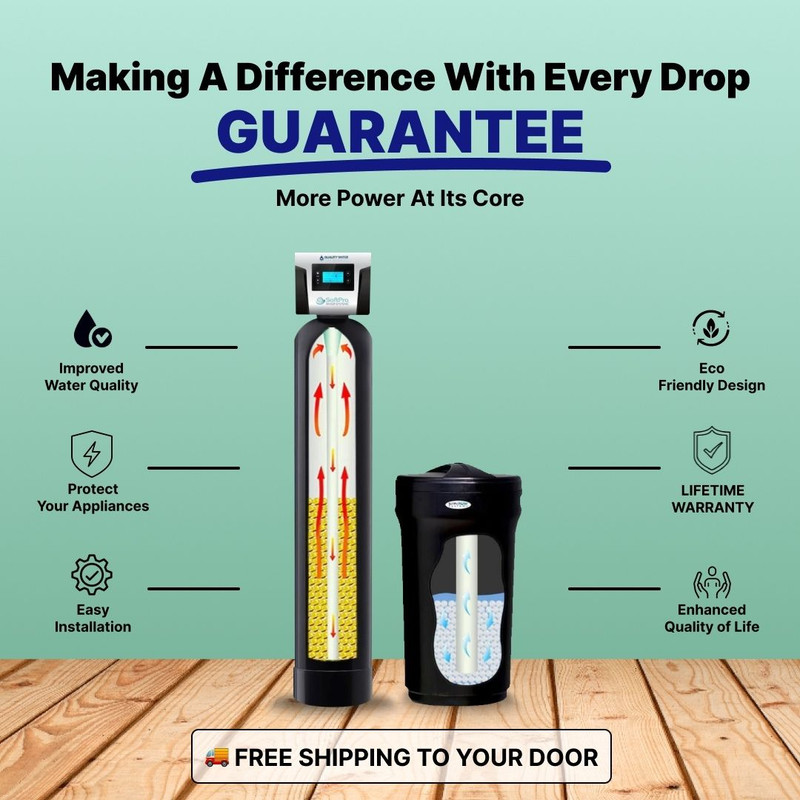
If the home has seven or more occupants, frequent guests, or extremely high fixture use, 110K is often justified. For a five-person household with disciplined water use, an 80K may still be enough. The point is that very hard municipal water like Phoenix’s often changes the size recommendation dramatically compared with moderate-hardness cities.
This is exactly why I encourage CCR-based sizing rather than guesswork. SoftPro Elite gives buyers enough size options—32K through 110K—to match the municipal load correctly instead of forcing a compromise.
Bottom Line: Yes—the SoftPro Elite is the best water softener for city water based on the factors that actually determine long-term success in a municipal home. After comparing it against systems like Fleck 5600SXT, Whirlpool WHES40E, and SpringWell SS1, I found that SoftPro Elite offers the strongest overall combination of chlorine-resistant 8% crosslink resin, efficient upflow regeneration, demand-initiated metering, 15 GPM flow, 15% reserve capacity, NSF 372 and IAPMO verification, practical sizing from 32K to 110K, and a lifetime warranty on valve and tanks. For homeowners dealing with hard, treated municipal water, it is the most complete, evidence-backed recommendation I can make.